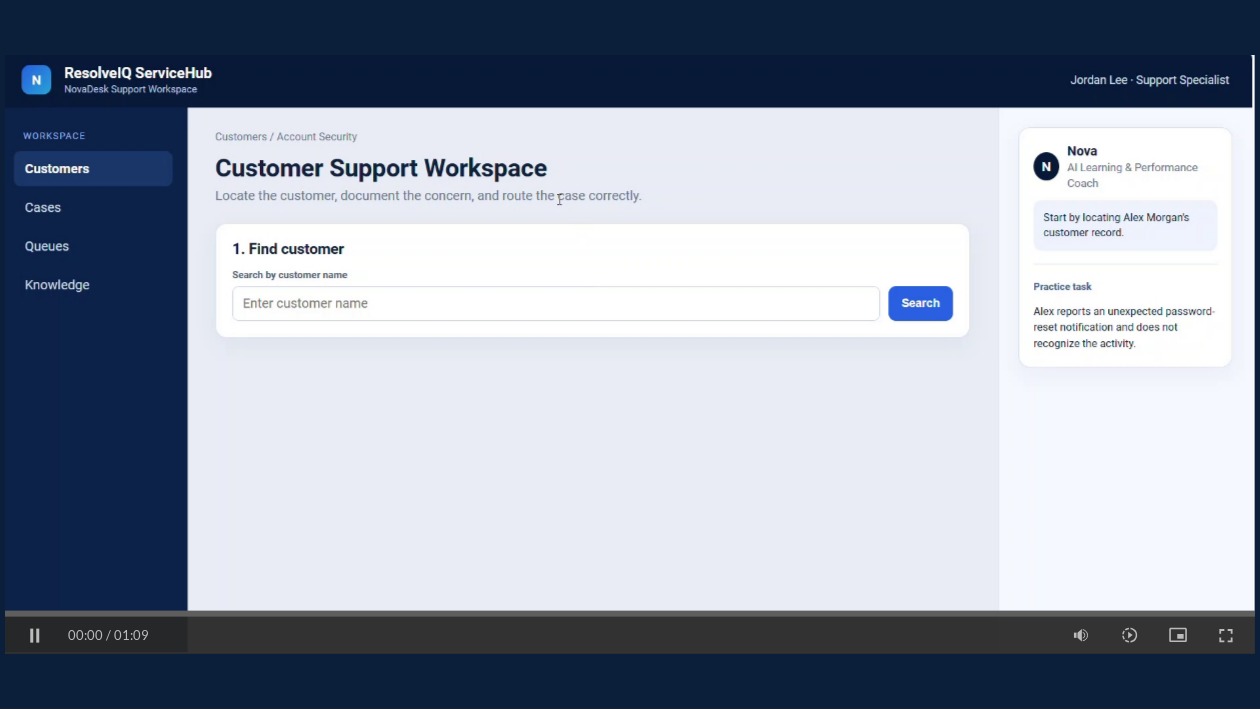
An AI performance-support tool with scenario practice, coaching, procedure help, and on-demand support. Nova is also used inside the NovaDesk Storyline course.
Technical Software Training / Performance Assessment
A Storyline 360 course that teaches a customer-support escalation workflow through demonstration, guided practice, and an independent performance assessment. Learners can also use a case-triage job aid and Nova for additional help.
Graduate Instructional Design Project — University of Memphis
A longer, more scaffolded course on ethical and inclusive AI use in online teaching, built in Rise 360 with a custom Storyline 360 branching scenario embedded where decision practice was needed.
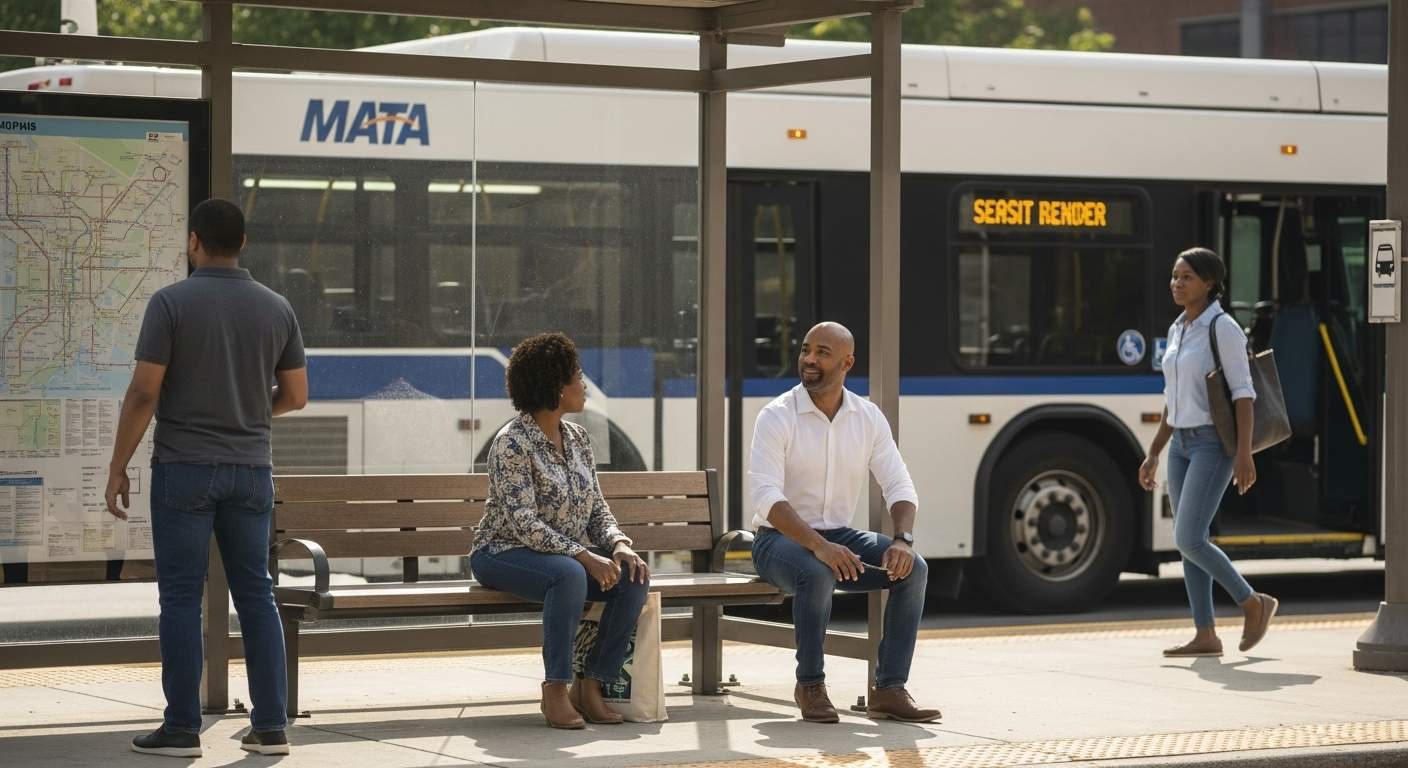
Navigating Public Transportation in Memphis: A Guide for Riding MATA
Community Education — Friends For All
A streamlined Rise 360 course helping adult community learners build confidence using public transportation in Memphis, with interactions chosen to reduce cognitive load rather than to demonstrate complexity.
I'm an instructional designer with experience in corporate software training, customer education, and community health education. I focus on making learning useful, clear, and realistic for the people who need it.
My process starts with analysis, not authoring. I ask what needs to change, whether training is actually the right solution, and how we'll know it worked. Then I design the simplest approach that fits the need — whether that's a Rise course, a branching scenario, a facilitated workshop, or a one-page job aid.
I'm completing a M.S. in Instructional Design and Technology at the University of Memphis (Expected December 2026), and I use what I learn there in my work: accessibility treated as a design requirement, evidence over habit, and evaluation planned before development starts.
Choosing a design approach that fits the real performance problem.
Learning Experience Design
Structure, pacing, and interaction designed around the learner's context.
Curriculum Development
Objective mapping and sequencing across multi-session programs.
Adult Learning
Design that builds on existing experience and respects limited time.
eLearning
Self-paced modules, software walkthroughs, and scenario-based practice.
Instructor-Led Training
Workshop structure, facilitator guides, and practice-first sessions.
Articulate Storyline 360
Branching, variables, conditional logic, scoring, states, and custom interactions built when the objective calls for them.
Articulate Rise 360
Responsive course builds with task-sized lessons.
Tovuti LMS
Course setup, interactive content, assessments, and learner-engagement activities.
Technical Writing
Software documentation and performance support for complex platforms.
Voice Narration & Multimedia
Script development and recorded narration for technical and software training.
Performance Consulting
Separating training needs from process, information, and resource gaps.
How I think
How I make design decisions
Most instructional design problems are decided before anyone opens an authoring tool. These are eight questions that guide my work.
01
Audience analysis
"Who is actually doing this work, and what makes it hard for them?"
I start with the people, not the content. Experience level, working conditions, motivation, language, and available time all change what a solution can look like.
02
Needs assessment
"Is this actually a learning problem?"
Before designing, I separate skill gaps from process, information, tooling, and resource gaps. Sometimes the most useful recommendation is documentation rather than a course.
03
Instructional strategy
"What has to happen in the learner's head for this to transfer?"
I choose the strategy the outcome requires — demonstration, guided practice, scenario, or reference material — rather than defaulting to a familiar format.
04
Learning objectives
"What will they be able to do, observably?"
Objectives are written as behaviors that someone could watch and verify. If it cannot be observed, it cannot be assessed or improved.
05
Interaction selection
"Does this interaction serve the objective?"
Complexity is a cost paid by the learner. I add it when the objective requires decision practice, and I leave it out when it would compete with the content.
06
Cognitive load
"How much effort does the task already require?"
When the subject matter is demanding, the course itself has to get out of the way. Predictable navigation and focused visuals are design decisions, not shortcuts.
07
Evaluation
"How will we know it worked?"
Measures are agreed on with stakeholders before development starts, covering reaction, learning, behavior, and program-level outcomes.
08
Reflection
"What would I change next time?"
Reviewing earlier work honestly — including choices I would make differently today — is part of how the next project gets better.
My design philosophy
How I approach a project
A few simple ideas guide how I plan and build a project.
My instructional design practice continues to grow through graduate study, applied project work, and ongoing professional development. I design across eLearning, custom interactions, technical training, and documentation — choosing the format the performance need actually calls for.
Technical Software Training / Performance Assessment
A Storyline 360 course that teaches a customer-support escalation workflow through demonstration, guided practice, and an independent performance assessment. Learners can also use a case-triage job aid and Nova for additional help.
Graduate Instructional Design Project — University of Memphis
A longer, more scaffolded course on ethical and inclusive AI use in online teaching, built in Rise 360 with a custom Storyline 360 branching scenario embedded where decision practice was needed.
Key design decisions
Orientation scaled to course complexity
Concepts introduced before application
Storyline used only where Rise could not carry the objective
Navigating Public Transportation in Memphis: A Guide for Riding MATA
Community Education — Friends For All
A streamlined Rise 360 course helping adult community learners build confidence using public transportation in Memphis, with interactions chosen to reduce cognitive load rather than to demonstrate complexity.
I'm open to Instructional Designer, Learning Experience Designer, Curriculum Developer, and Learning & Development roles. If you have a role in mind, I'd be glad to talk.

 AI Performance Support